Sendlore for founders & builders
Keep the research behind your product decisions findable.
Save competitor pages, customer evidence, technical references, launch examples, product ideas, and working notes with the reason they mattered. Sendlore turns that scattered research into a searchable personal library you can revisit when the next decision, sprint, or launch needs it.
Built for a personal research library. Sendlore is not a team project-management workspace.
The founder research problem
Your product memory is usually split across tabs, bookmarks, screenshots, docs, chats, and your head.
Founders rarely research one clean topic at a time. A pricing decision can depend on competitor pages, Reddit complaints, customer calls, an old launch thread, analytics notes, and a framework you saved months ago. The failure point is not always finding information the first time. It is recovering the right evidence when the decision comes back.
Save the evidence, not just the URL
Keep the original source with your own note about the feature, objection, positioning idea, implementation detail, or decision it relates to.
Separate capture from perfect organization
Folders and tags are available when useful, but retrieval does not depend on remembering a flawless filing system months later.
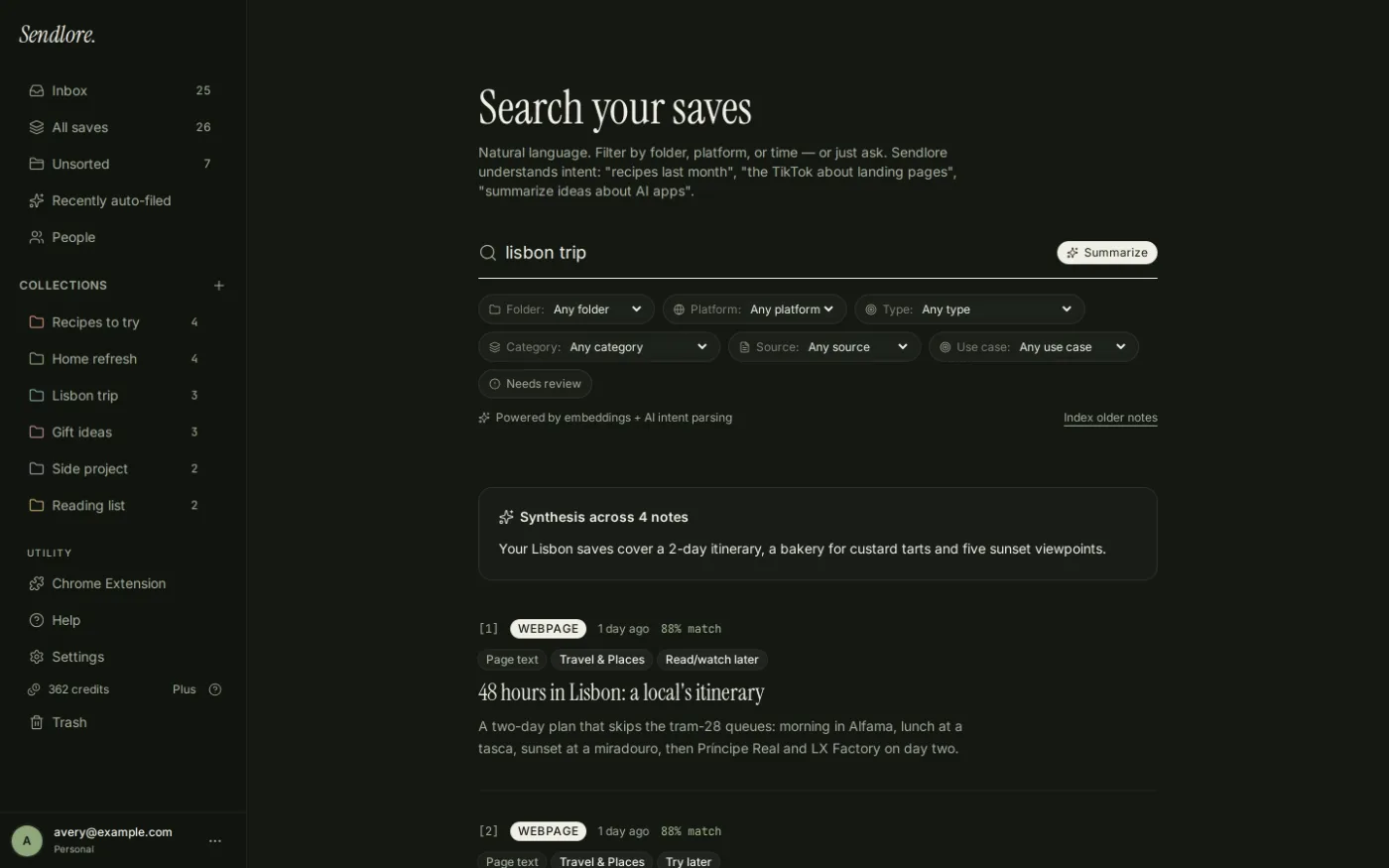
Search by the fragment you still remember
Use a company, feature, problem, quote, idea, platform, or remembered detail. Search combines normal text matching with semantic similarity when the saved evidence supports it.
Reuse research across product cycles
The same source can matter during discovery, positioning, roadmap work, implementation, launch, and later iteration instead of disappearing with the original sprint.
Founder workflows
Build a source library around the decisions you make repeatedly.
Sendlore is most useful when the information has a reason to come back. These are the research loops where a persistent library compounds instead of becoming another dumping ground.
Capture with intent
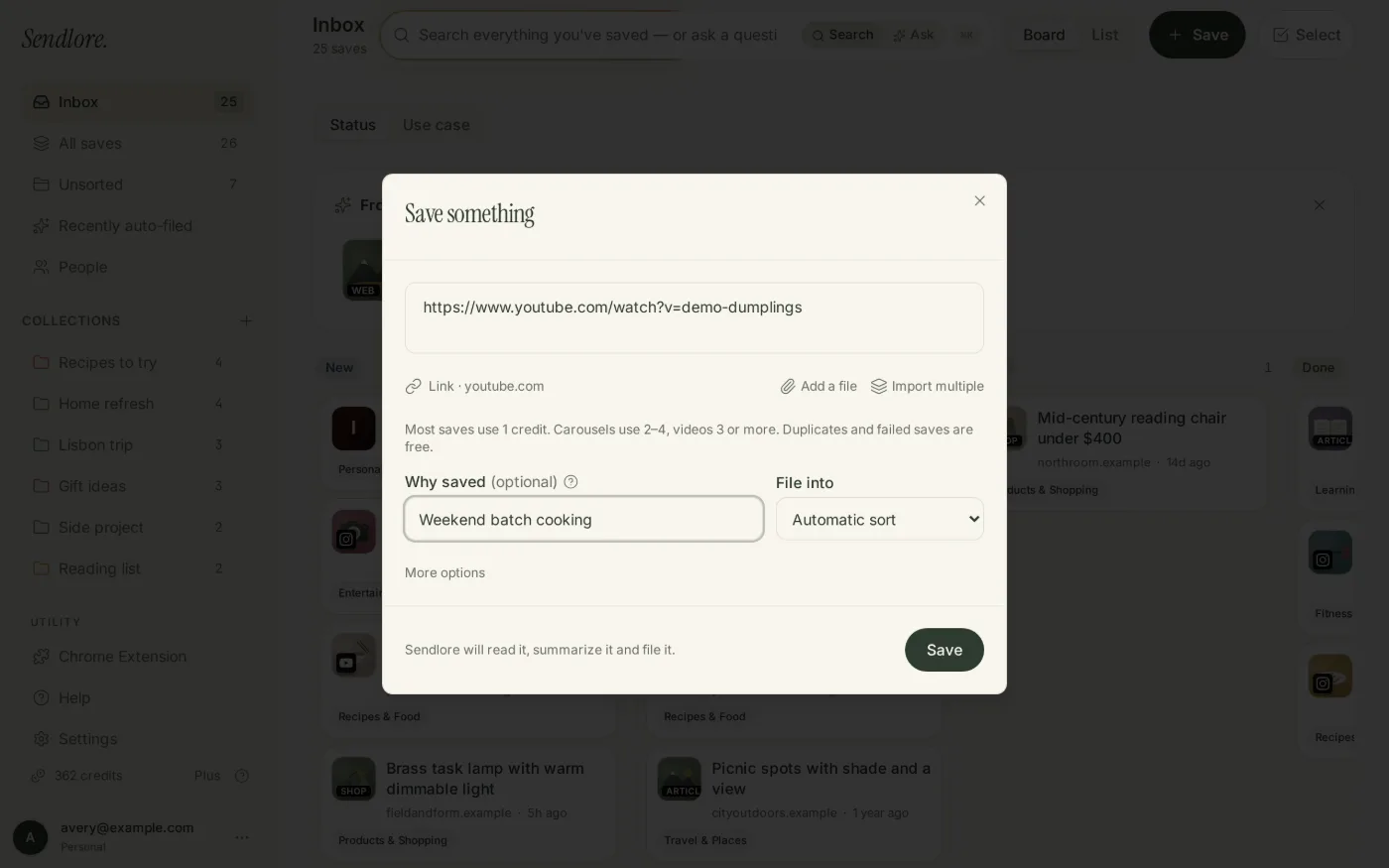
Write down why you saved it while you still know.
A bare bookmark answers “where was the page?” but not “why was this important?” Sendlore’s capture flow gives you a place to preserve that intent beside the source, which can make the save much more useful after the immediate research session ends.
From research to decision
Make past research available at the moment of choice.
The value is not a larger archive. It is shortening the distance between “we looked into this before” and the evidence that can actually inform what you do next.
Ask your saved research
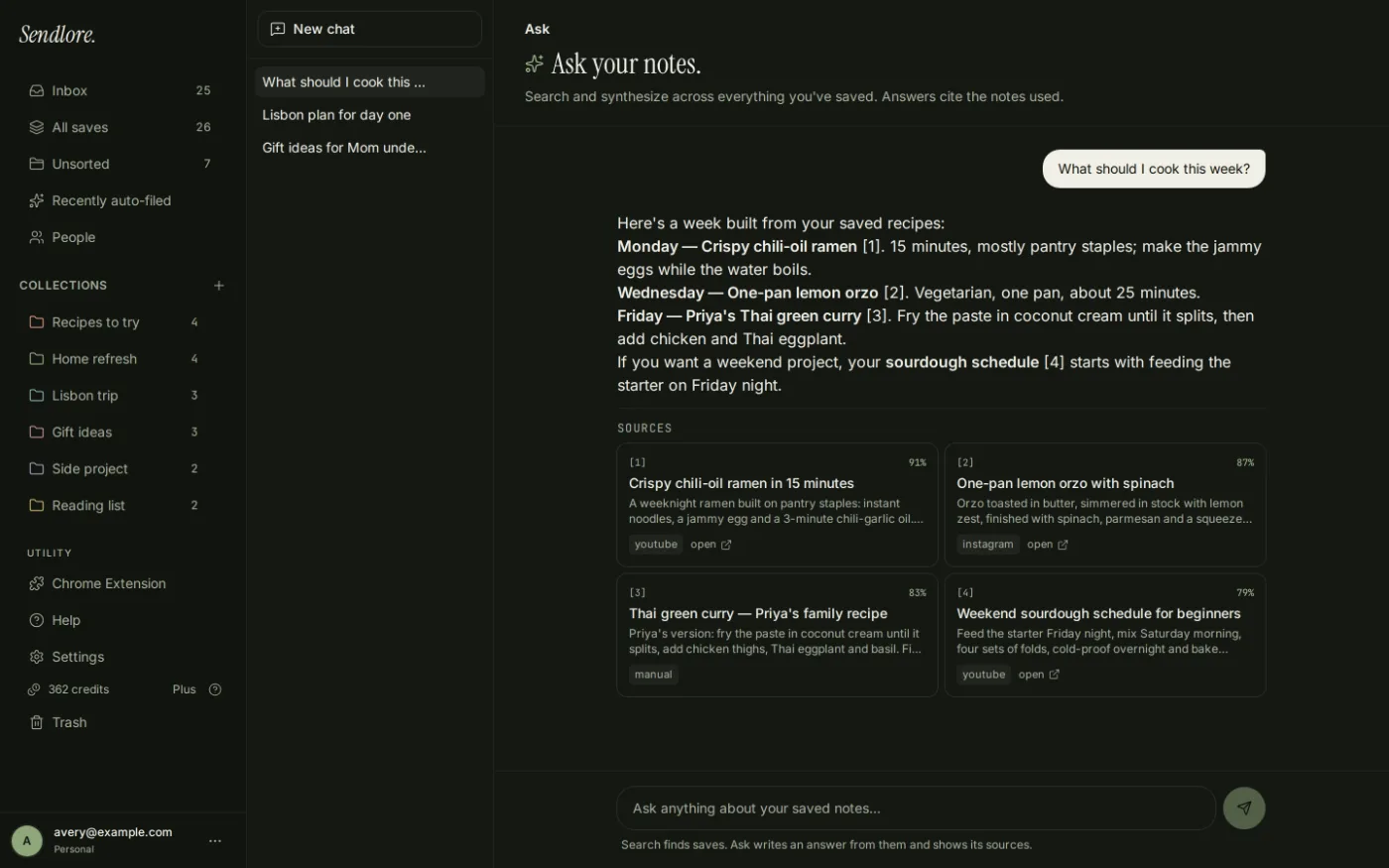
Interrogate the material you already collected before opening another research loop.
Ask is useful when the answer may be spread across several saved items: what objections keep appearing, which competitors use a certain pricing pattern, what implementation approaches you saved, or what evidence you collected around a product assumption.
Its usefulness depends on what Sendlore successfully captured. Important product, market, legal, security, and technical decisions still require checking the underlying source and current reality.
Search by memory
You do not need to remember which folder contained the thing.
Founder recall is usually contextual: “that Reddit thread about failed imports,” “the pricing page with usage-based credits,” or “the GitHub issue explaining the retry problem.” Sendlore’s search is designed around those fragments.
- “competitor pricing pages I saved for packaging”Search by the decision context rather than an exact page title.
- “customer complaints about importing data”Resurface feedback and references around a recurring problem.
- “GitHub threads about retry queues”Recover technical material based on the implementation detail you remember.
- “launch examples from last month”Combine topic and time cues to narrow the library.
Where Sendlore fits in the stack
A research memory layer, not another system of record.
Keep GitHub, Linear, Notion, your CRM, analytics, and product docs.
Sendlore is not a source-control system, issue tracker, collaborative wiki, CRM, analytics platform, or formal decision-log product. Its role is narrower: capture useful external and personal research with source context, make it retrievable later, and help you reuse the evidence behind product work. Current Sendlore accounts are personal rather than shared team workspaces.
Evidence boundaries
Not every source gives Sendlore the same amount of information.
A public article may yield rich text. A restricted page or platform may provide only metadata. A video may have a transcript, or it may not. Sendlore keeps the source useful even when deeper extraction is limited, but Search and Ask can only work with the evidence actually captured.
Sendlore personal libraries are designed to be private by default, with authenticated owner-scoped access and deliberate sharing for individual saves. Review the Security & Privacy page for current details rather than relying on blanket claims about encryption or third-party processing.
Questions
Sendlore for founders and builders FAQ
What should a founder save in Sendlore?
Anything likely to matter again: competitor pages, market research, customer evidence, technical references, launch examples, product inspiration, screenshots, notes, useful videos, and links related to an active or future product decision.
Can Sendlore organize competitor research?
Yes. You can save competitor pages and supporting research, add your own reason or observation, organize items with folders and tags, and later retrieve them through search or Ask. Sendlore does not automatically guarantee a complete or current competitive-intelligence database.
Can I use Sendlore for customer feedback?
You can save supported sources, notes, screenshots, and references that contain useful customer evidence and attach context about the product problem they relate to. Sendlore is not a CRM or dedicated feedback-management platform.
Can Sendlore search technical documentation and GitHub references?
It can save URLs and supported captures and make successfully captured text and your own notes searchable. Access restrictions, dynamic pages, and other source limitations can reduce extraction depth, so keep the original link as the authoritative reference.
Is Sendlore a team knowledge base?
No. The current product is built around personal, owner-scoped libraries rather than multi-user team workspaces. It can complement the shared systems your team already uses, but it should not be positioned as a replacement for a collaborative wiki or project-management tool.
Can I import my existing bookmarks?
Yes. Sendlore supports browser bookmark imports and supported saved-content exports. Imported links can remain useful as light saves and gain richer searchable context when deeper processing succeeds.
Is my product research public?
Personal libraries are designed to be private by default. Sharing an individual save is a deliberate action. See Sendlore Security & Privacy for current implementation details and limitations.
Stop rebuilding the same research trail
Keep the evidence behind the product, not just the product.
Save useful sources with the context that made them matter, then find that research again when the next feature, pricing decision, implementation problem, or launch needs it.