Sendlore vs. Readwise Reader
A Readwise Reader alternative for saving research you need to find and reuse later.
Readwise Reader is a mature reading system for articles, newsletters, EPUBs, PDFs, videos, tweets, RSS, highlights, annotations, and long-term review. Sendlore is aimed at a different center of gravity: capture mixed online sources with context, preserve why they mattered, and retrieve the research again when a project needs it.
Independent comparison. Readwise and Reader are not affiliated with Nero Niche or Sendlore. Readwise details were checked against its public product and help documentation on October 7, 2026.
Choose Readwise Reader if reading, highlighting, annotating, RSS/newsletters, text-to-speech, offline access, native mobile apps, export to note-taking tools, and resurfacing what you read are central to your system. Choose Sendlore if your main problem is collecting mixed web research, keeping the original source and your reason for saving it together, importing old saved-link backlogs, and finding that material again by words, meaning, or source-grounded questions.
Side-by-side
Both can become a research library. They optimize different parts of the workflow.
Reader is reading-first. Sendlore is retrieval-first. That distinction matters more than a feature-count comparison.
| Capability | Sendlore | Readwise Reader |
|---|---|---|
| Best fit | Mixed online research, saved references, competitor research, writing sources, project evidence, links, notes, files, videos, and social content you expect to retrieve later. | Serious reading workflows: articles, newsletters, EPUBs, PDFs, videos, tweets, RSS, highlighting, annotations, review, and long-form knowledge capture. |
| Capture model | Save a source, keep its original URL, add your own “why I saved this” context, and enrich it when Sendlore can successfully read the source.Context-first | Save readable documents through its browser extension, share sheet, files, imports, RSS, and newsletters; Reader is built to turn content into a reading surface.Reading-first |
| Mixed source support | Designed around links, articles, videos, social posts, notes, images/files, browser bookmarks, and supported social/video export workflows. Depth varies by source. | Officially supports articles, newsletters, EPUBs, PDFs, videos, tweets, RSS, file uploads, and imports from services such as Pocket, Instapaper, and Feedly. |
| Search | Hybrid retrieval combines exact/full-text signals with semantic similarity and structured filters across captured library data. | Full-text library search covers document text, titles, and authors; Reader also offers filtering and a server-side Better Search mode. |
| Ask across the library | Ask retrieves relevant saved notes, synthesizes from that evidence, and returns numbered references and source cards. | Global Ghostreader searches the Reader library on web/desktop, answers with citations, and links directly to supporting passages. |
| Personal save context | A dedicated “why I saved this” field makes your own reason for keeping the source part of the record and later retrieval context.Sendlore emphasis | Reader supports document notes, highlights, tags, annotations, summaries, and metadata. Its core workflow emphasizes reading and annotation rather than a dedicated capture-time reason field. |
| Highlighting & annotation | Not the center of the product. Sendlore is built more around the saved item, extracted evidence, your note, search, and Ask. | Deep highlighting, annotation, highlight tags, notebooks, keyboard workflows, and automatic sync into the Readwise highlight library.Clear Reader edge |
| Reading experience | Stores captured content and summaries for retrieval, but is not positioned as a dedicated long-form reader. | Dedicated reading interface, configurable typography, paged scrolling, offline use, text-to-speech, and document-level Ghostreader.Clear Reader edge |
| RSS & newsletters | Not a dedicated feed reader. | Built-in RSS/feed workflows and newsletter ingestion are core Reader capabilities.Clear Reader edge |
| Importing old saves | Supports browser bookmarks, pasted URL lists, and current import paths for several social/video saved-content exports. Light import can bring in a large backlog before deeper processing. | Supports imports from Pocket, Instapaper, Feedly, and other reading services, plus file and OPML workflows. |
| Export ecosystem | JSON and Markdown export for moving saved information out of Sendlore. | Highlights sync through Readwise and can export to tools such as Notion, Obsidian, Roam Research, Logseq, Evernote, and others.Reader ecosystem edge |
| Mobile & offline | Responsive web app plus Chrome extension. No native mobile app currently. | Native mobile apps, desktop app, and offline reading on web/mobile when content is available locally.Clear Reader edge |
| Pricing model | Free plan available. Current paid tiers start at $9/month; reading credits are used when Sendlore processes new source content, while Search, Ask, and export do not spend reading credits. | 30-day free trial, then full Readwise including Reader is currently $9.99/month billed annually or $12.99 billed monthly. |
Readwise details above are based on the official Reader documentation, Global Ghostreader documentation, search documentation, and current pricing page. Sendlore claims are checked against the current Sendlore product implementation and live Nero Niche product pages.
Where Sendlore differs
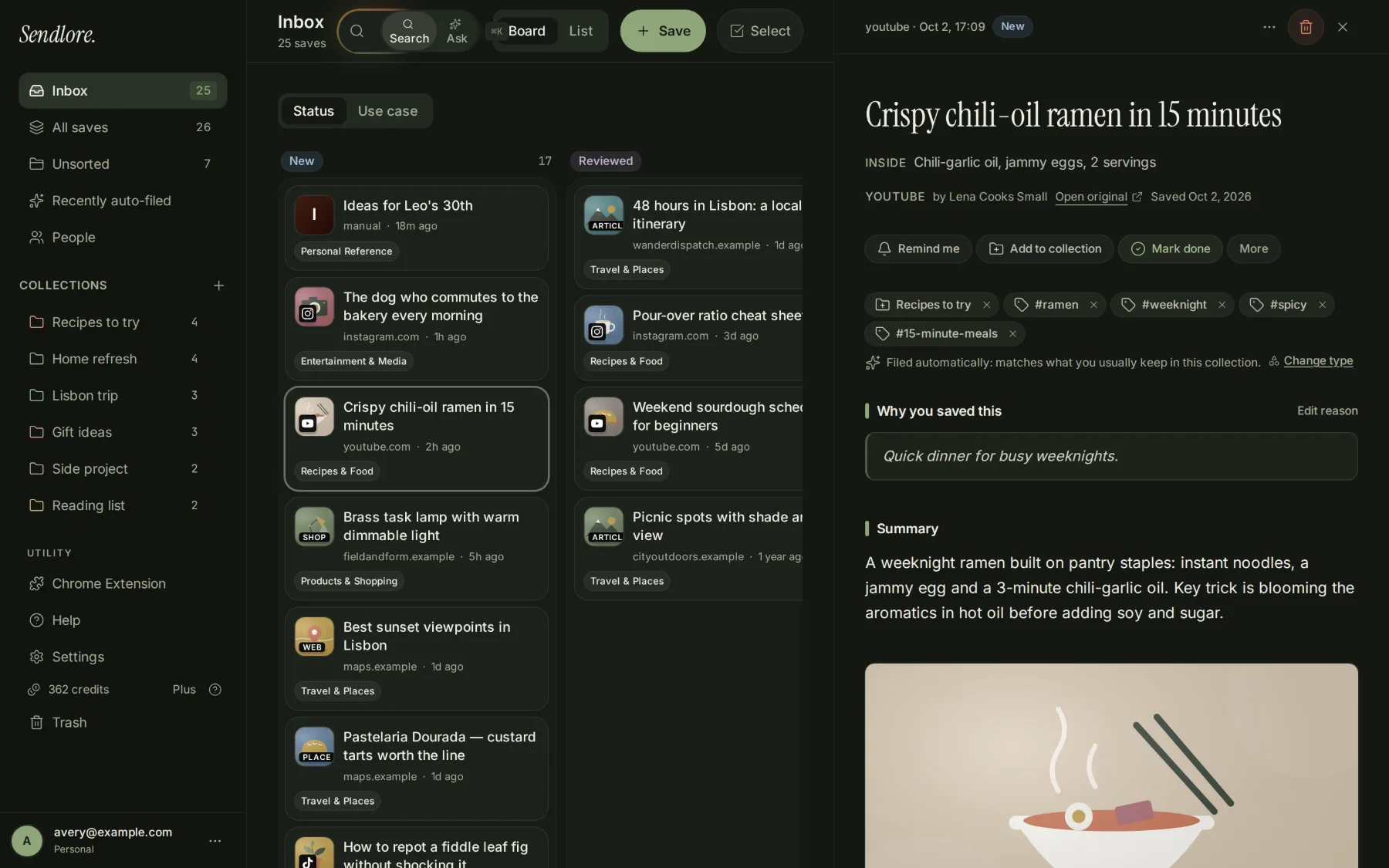
Save the reason, not only the document.
A research library often fails before search even begins: months later, the source is still there but the reason you saved it is gone. Sendlore makes that personal context part of the capture workflow.
Finding research again
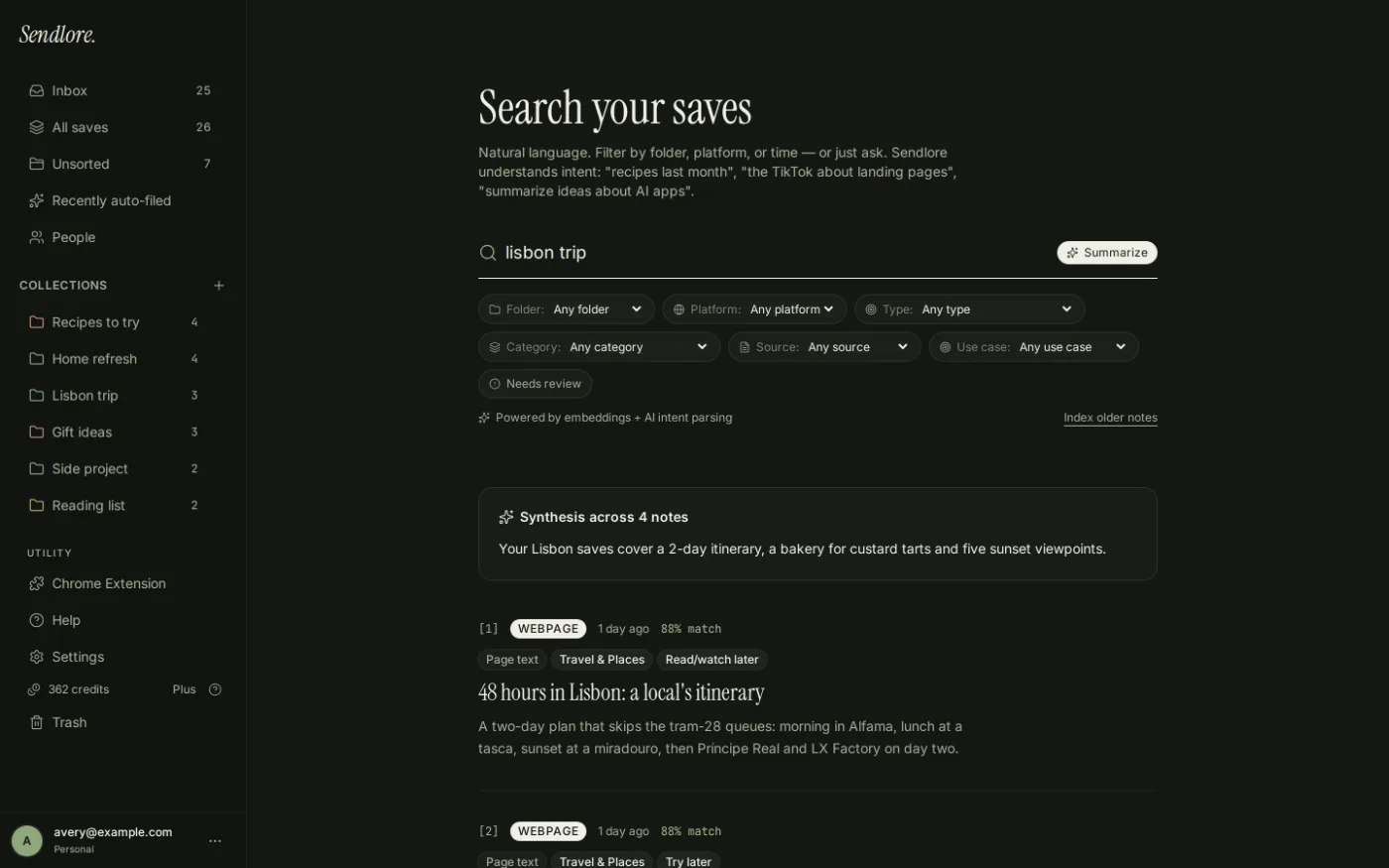
Reader and Sendlore are both strong here — but the retrieval surfaces differ.
Reader now has serious library search and Global Ghostreader, so it would be inaccurate to frame Sendlore as the only option for semantic or AI-assisted retrieval. The meaningful difference is the information each library is designed to preserve around the source.
Where Readwise Reader is better
If your system revolves around reading and highlighting, Reader is the stronger product.
This is not a gap Sendlore should disguise. Reader is a much deeper reading environment.
Reader is built for long-form consumption: clean article reading, EPUBs, PDFs, configurable typography, text-to-speech, keyboard navigation, and offline access.
Highlights and notes flow into Readwise, where they can be tagged, searched, resurfaced through Daily Review, and exported into established note-taking systems.
Reader can operate as an RSS and newsletter inbox, including OPML imports and feed subscriptions. Sendlore is not trying to replace a feed reader.
Choose by workflow
The better tool depends on what happens after you press Save.
You read, mark up, and retain.
- You want a polished place to read articles, PDFs, EPUBs, newsletters, and feeds.
- Highlighting and annotation are central to how you learn.
- You want Readwise Daily Review or spaced resurfacing of highlights.
- You need native mobile apps and dependable offline reading.
- You export heavily into Obsidian, Notion, Logseq, Roam, or similar tools.
- You want library-wide AI that can cite passages inside saved documents.
You collect research to reuse.
- You save mixed web sources more often than you sit down to read them end-to-end.
- You want to preserve why a source mattered at the moment you saved it.
- You want links, social saves, videos, notes, files, and imported backlogs in one retrieval-oriented library.
- You care about semantic search and source-grounded Ask without building a highlighting habit first.
- You want a free plan rather than a time-limited trial.
- You prefer the original source to remain the center of the saved record.
Mixed-source research
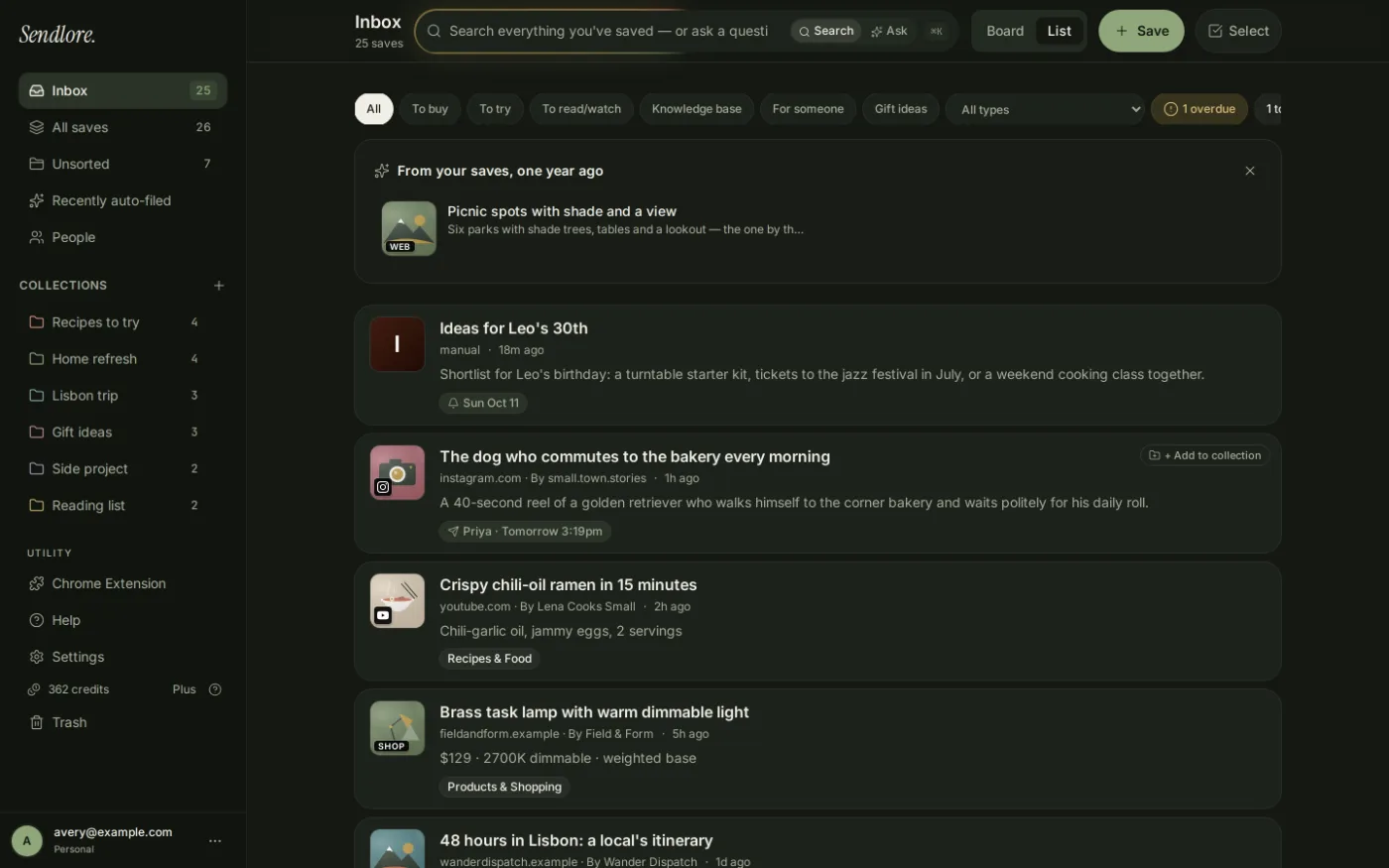
Sendlore treats imperfect web captures as part of the real workflow.
Research does not only arrive as clean articles. It can be a YouTube video, social post, image, product page, browser bookmark, note, PDF, or source that exposes only partial metadata. Sendlore is designed to keep those differences visible.
Cost and complexity
Sendlore is easier to try indefinitely. Reader bundles more mature reading infrastructure.
Price should be read together with product scope. Reader’s subscription includes a much deeper reading/highlight ecosystem. Sendlore’s free tier and credit model are designed around paying for new-source processing rather than charging for ordinary retrieval.
Free plan available.
- Current paid tiers start at $9/month.
- Credits are used when Sendlore reads/processes new material.
- Search, Ask, and export do not consume reading credits.
- You can keep using the product without converting from a trial just to maintain access.
30-day free trial.
- Full Readwise including Reader is currently $9.99/month when billed annually.
- Monthly billing is currently $12.99/month.
- The subscription includes Reader and the broader Readwise highlight/review system.
- Some advanced Ghostreader scenarios can optionally use your own OpenAI API key.
Questions
Sendlore vs. Readwise Reader FAQ
Is Sendlore a full replacement for Readwise Reader?
Not for every workflow. Sendlore can replace the save-and-retrieve part of a research system, especially if you work with mixed online sources and care about preserving capture context. It does not currently match Reader’s dedicated reading interface, deep highlighting/annotation workflows, RSS/newsletter feeds, text-to-speech, native mobile apps, offline reading, or Readwise review ecosystem.
Which is better for research retrieval?
Both are capable. Reader offers full-text search and Global Ghostreader with source-linked citations. Sendlore combines hybrid search with an explicit “why I saved this” field, mixed-source capture, and Ask answers tied back to saved notes. The better fit depends on whether your research begins with reading/highlighting or with collecting diverse sources for later reuse.
Does Readwise Reader have AI search across the whole library?
Yes. As of October 7, 2026, Global Ghostreader on Reader web and desktop can search across the library, answer questions with citations, and link back to the supporting passages. Reader also provides document-level Ghostreader.
What does Sendlore preserve that matters for later research?
Sendlore keeps the saved source, source/platform information, your own “why I saved this” context, and richer captured material such as summaries, readable text, transcripts, OCR, or takeaways when available. Search and Ask use the evidence that actually exists on the saved item.
Which is better for PDFs, EPUBs, highlights, and reading?
Readwise Reader. It is purpose-built for reading and annotation across those formats, while Sendlore is better understood as a source-aware research inbox and retrieval library.
Which is better for social posts, links, videos, and a messy bookmark backlog?
Sendlore is more directly aligned with that use case. It supports mixed saved sources, browser bookmarks, pasted URL lists, and several current social/video import paths while keeping capture fidelity visible. Reader also supports videos, tweets, imports, and many document types, but its workflow is centered more strongly on reading and annotation.
Which has the better mobile experience?
Readwise Reader currently has the clear advantage. Reader has native mobile apps and offline reading support. Sendlore currently uses a responsive web app plus a desktop Chrome extension.
Can I try Sendlore without paying?
Yes. Sendlore has a free plan. Readwise Reader currently offers a 30-day trial before requiring a paid Full Readwise subscription.
Reading system or research retrieval system?
Choose Sendlore when the next use matters more than the reading queue.
Capture mixed research, record why it mattered, keep the source attached, and build a library you can search or question when the next article, product decision, comparison, or project needs the evidence again.