Save
Capture the link, video, post, note, file, or forwarded email before it disappears into open tabs or another app.
Sendlore second brain
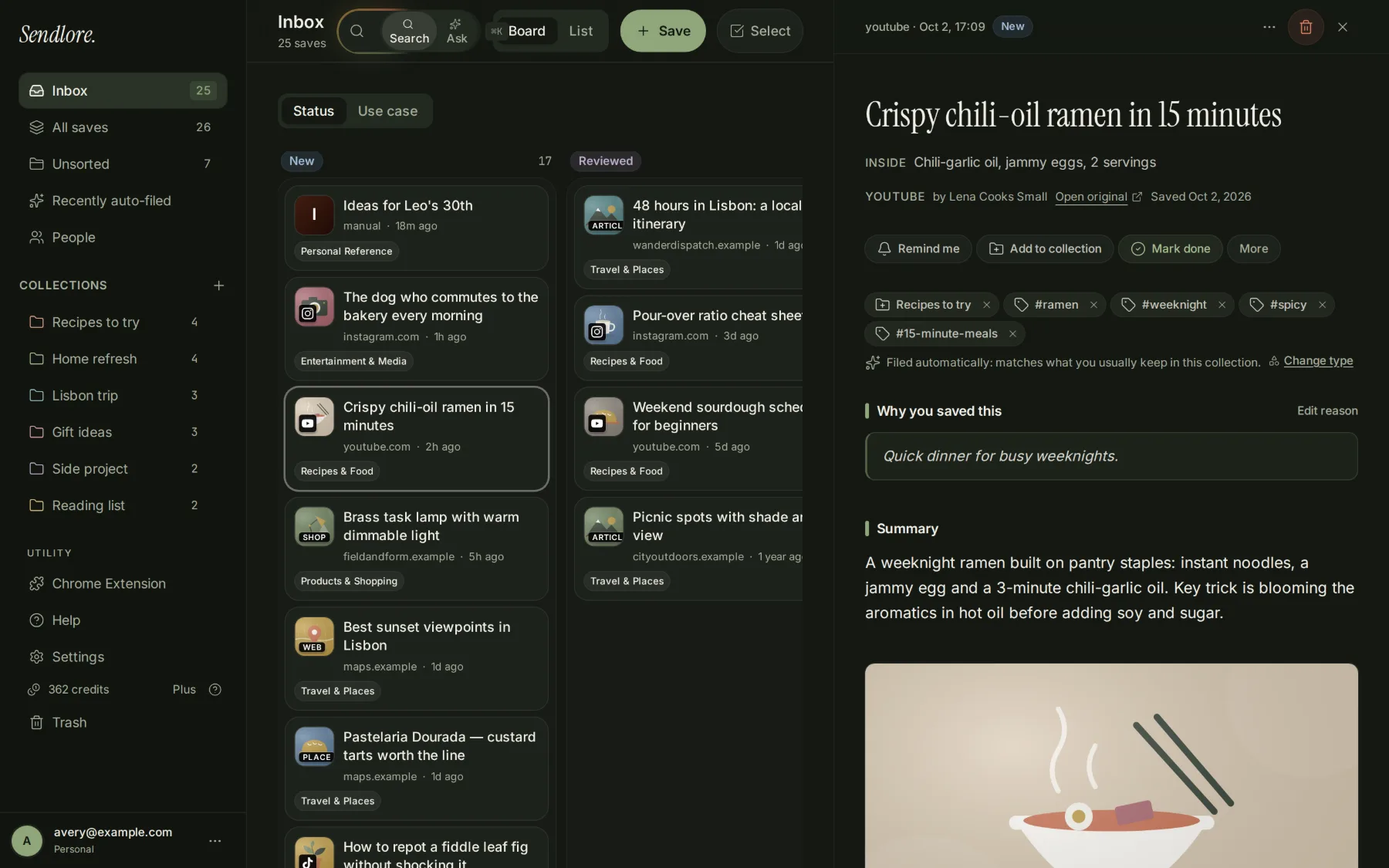
Save links, videos, posts, notes, files, and research with the reason they mattered. Sendlore organizes what it can, preserves the source, and helps you find the material later by what you remember — without requiring you to build a complicated personal wiki first.
Free plan available. Single-user library. The depth Sendlore can capture varies by source.
What a second brain should do
Many personal knowledge systems work best when you maintain folders, links, tags, templates, and notes with discipline. Sendlore is designed for a lighter loop: save useful material in the moment, add a little context, let the app help with organization, and rely on retrieval when you need it again.
Capture the link, video, post, note, file, or forwarded email before it disappears into open tabs or another app.
Write one line about why it matters: the project, idea, person, decision, or question that made it worth keeping.
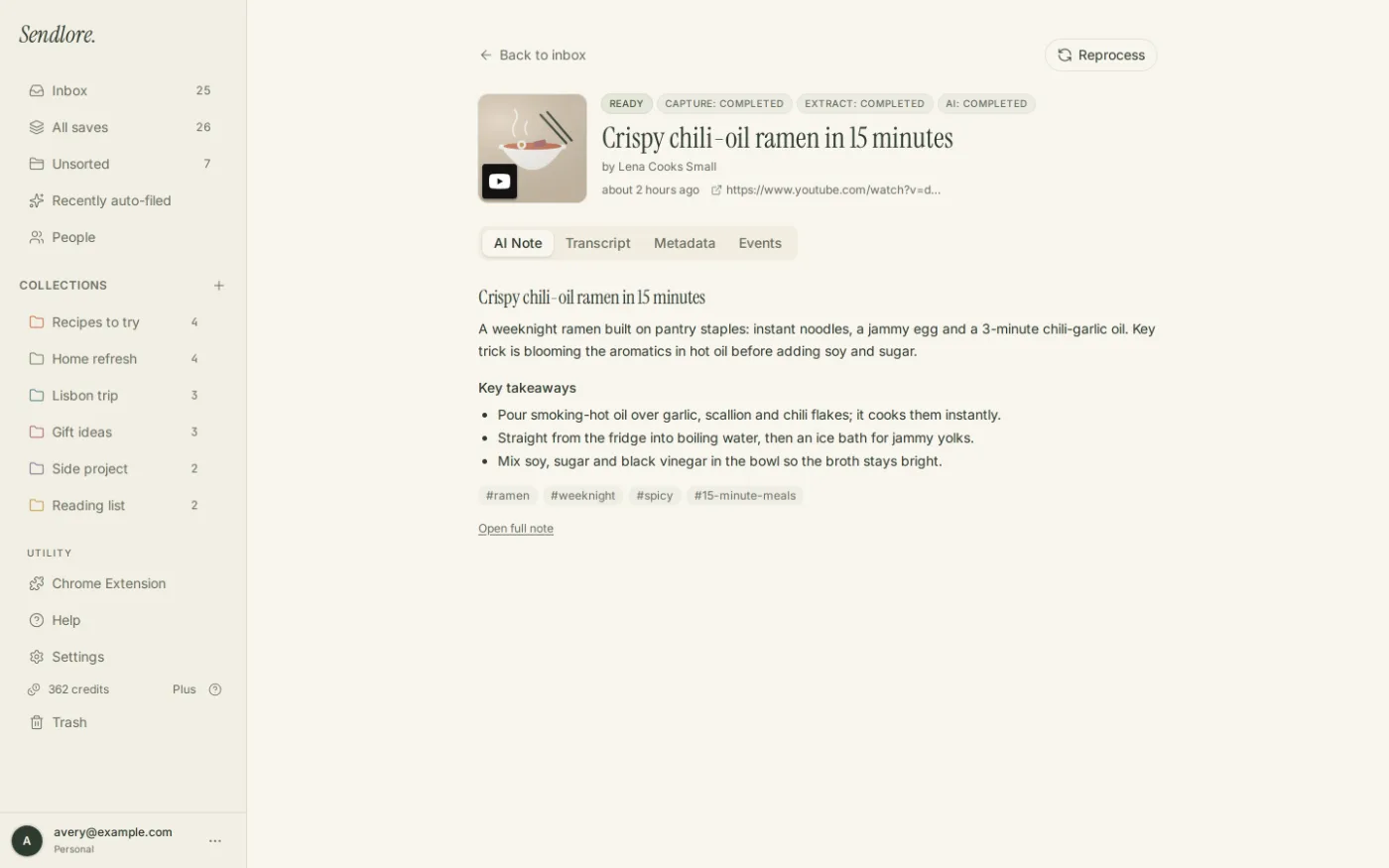
When the source allows, Sendlore can preserve readable text, transcripts, summaries, takeaways, source metadata, and useful classification.
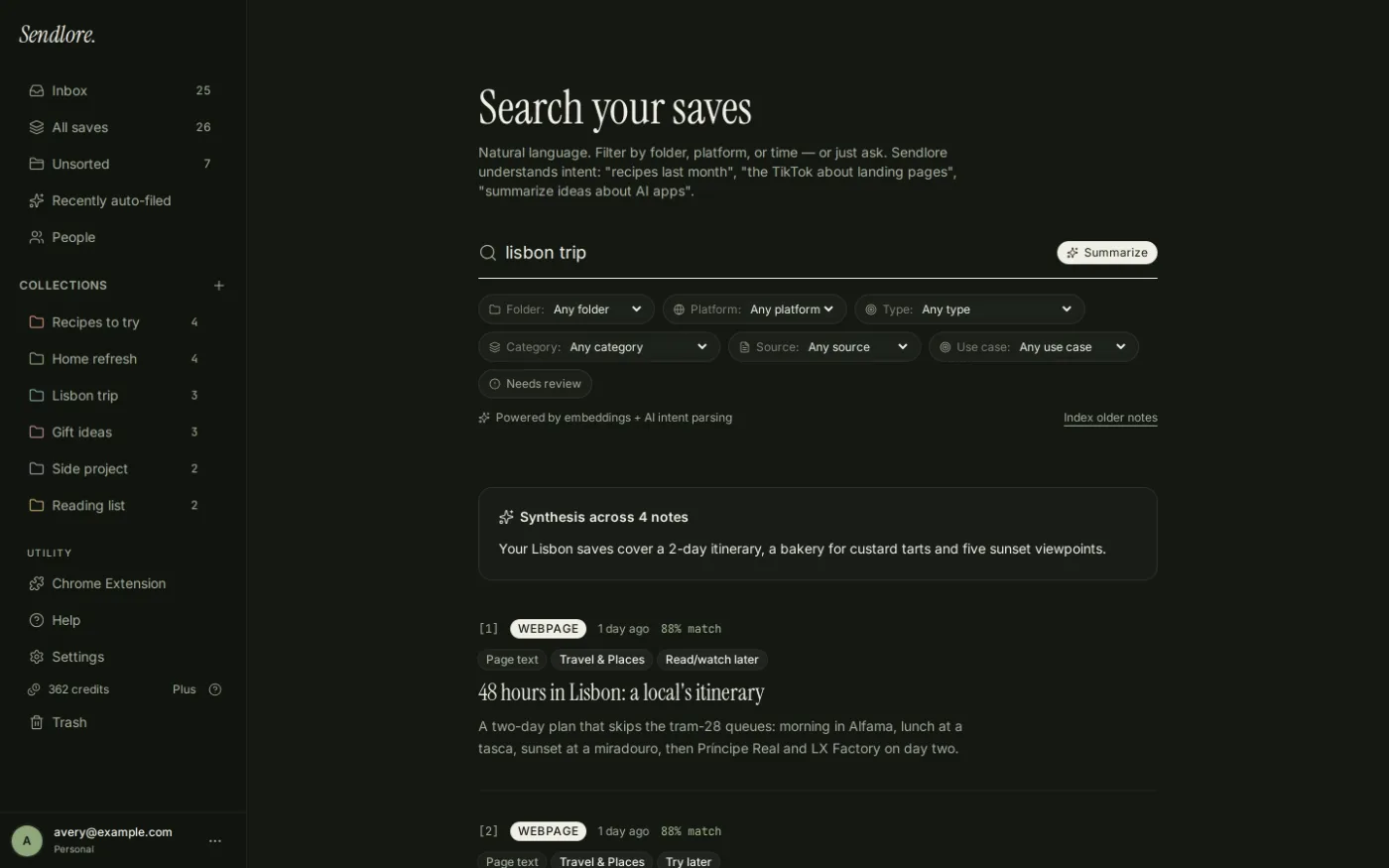
Search by words or meaning, or ask a question across relevant saves and follow the answer back to the supporting sources.
Low-maintenance by design
Folders and tags are available, but they are not the only path back. Sendlore is built so retrieval can work across the information attached to a save instead of forcing every useful source into a perfect hierarchy.
A second brain you can question
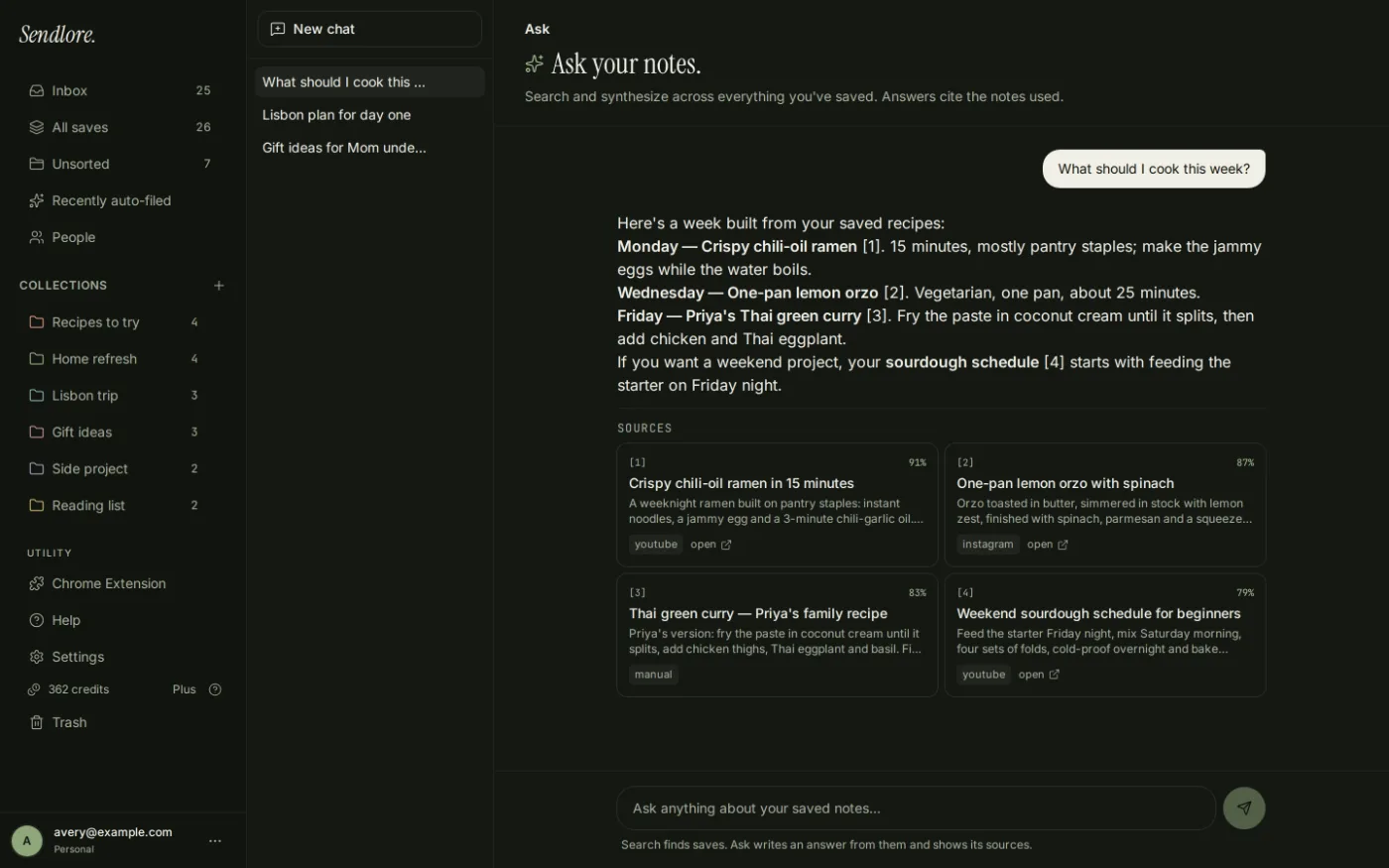
Sometimes the useful answer is spread across five saves. Ask retrieves relevant material from your Sendlore library, writes from that evidence, and shows the sources behind the response.
What belongs in it
Sendlore is not limited to text notes. It is designed around the external sources people save throughout the day, while preserving the differences between those source types.
Keep the original URL and, when the site allows it, readable text and generated notes that make the source easier to retrieve later.
Store source details and searchable transcript material when a usable transcript is actually available.
Keep social links alongside the rest of your research. Capture depth varies by platform and may remain metadata-only when deeper content is unavailable.
Create a note directly when the knowledge comes from you rather than an external source.
Upload supported files and let Sendlore extract or transcribe searchable information when processing succeeds.
Send useful email content to your personal Sendlore address instead of leaving it buried in an inbox.
Start with what you already saved
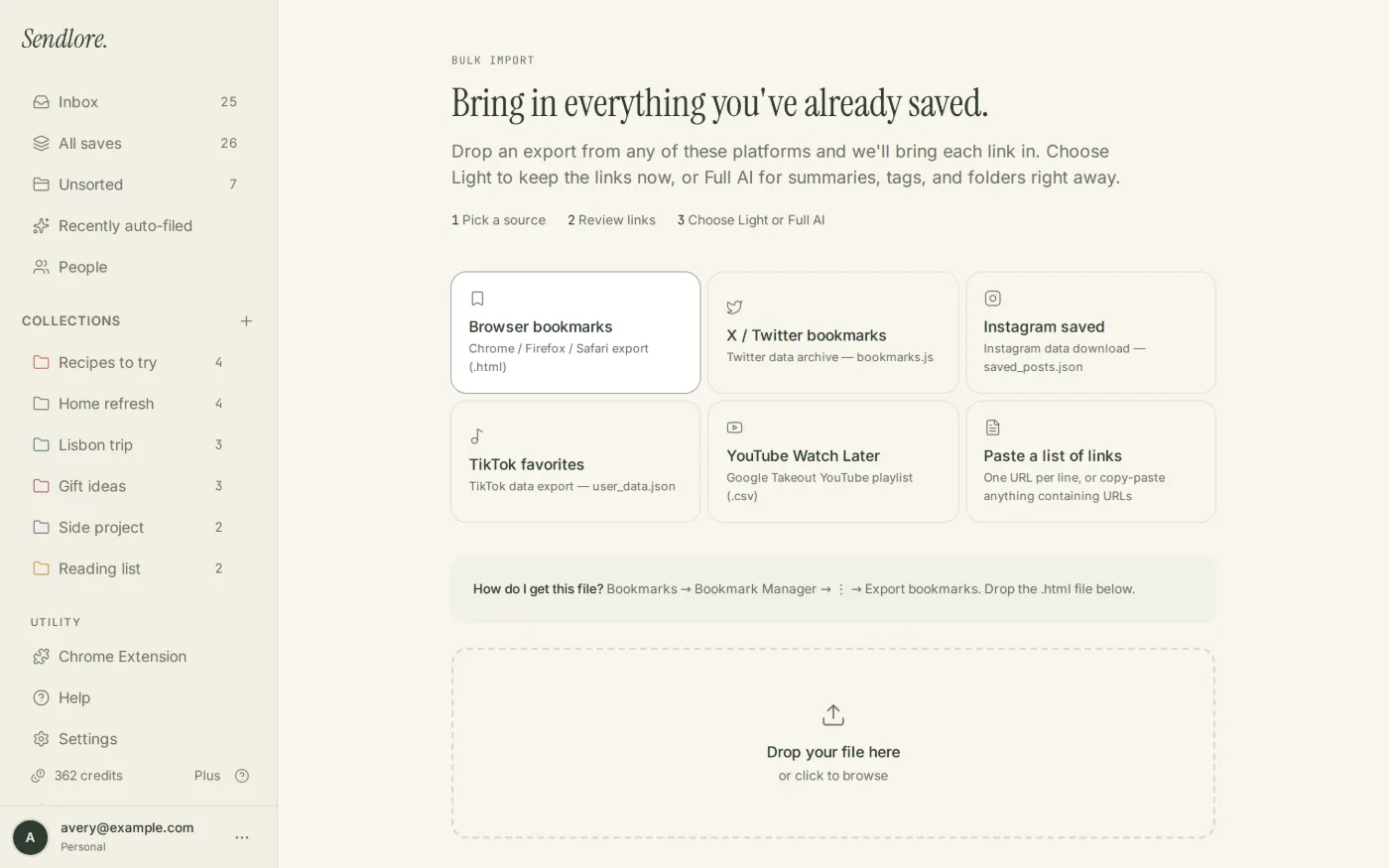
Bring an existing backlog into Sendlore rather than rebuilding your memory system from scratch. Imports can enter the library lightly first, then richer processing can be applied to the sources still worth keeping.
A different kind of second brain
That boundary is intentional. Sendlore is strongest as a personal source library and retrieval layer. If your main goal is building elaborate linked notes, project databases, team documentation, or a visual knowledge graph, another category of tool may fit better.
Keep the evidence honest
A saved URL is not the same thing as a fully captured source. Sendlore keeps that distinction visible because Search and Ask are only as reliable as the evidence stored with each item.
Use it where you already work
Sendlore is designed as a personal library, but useful knowledge should remain portable and accessible from other workflows.
No native mobile app. No shared team workspace. No universal full-text capture from every social platform or paywalled page. No promise that every save gets a transcript or summary. The web app works on phones, the Chrome extension handles richer desktop capture, and the product preserves lighter or metadata-only saves when deeper extraction is not available.
Questions
A second brain app is an external system for capturing information you want to remember and retrieving it later. Different tools emphasize different workflows: some focus on note writing and linking, while Sendlore focuses on saved sources, personal context, search, and retrieval.
A notes app usually begins with something you write. Sendlore often begins with something you found: a webpage, video, social post, file, email, or bookmark. It keeps that source connected to your own reason for saving it and to whatever evidence Sendlore could successfully capture.
No. You can use folders, types, and tags, but Sendlore also classifies and can help file saves automatically. Those decisions remain editable. Search and Ask also reduce how much the system depends on remembering the exact folder later.
Yes. Sendlore combines semantic retrieval with exact and full-text signals across the information stored in your library, so you can search by an idea or remembered detail without knowing the exact title.
Yes. Ask retrieves relevant saves, writes an answer from that evidence, and shows numbered references and source cards. The current answer policy is designed to avoid filling missing evidence with outside knowledge.
Yes. Sendlore supports browser bookmark imports, pasted URL lists, and current import workflows for X bookmarks, Instagram saved posts, TikTok favorites, and YouTube exports. Import fidelity depends on the data available in each source export.
On eligible paid plans, Sendlore can connect to supported AI assistants so they can search your library and save links for you. This extends the library into another workflow instead of making Sendlore the only interface you can use.
Your personal library is private by default. Individual saved notes can be shared deliberately. For current details about data handling and account security, review the Sendlore Security & Privacy page.
No. Sendlore currently uses a responsive web app on phones and desktops plus a Chrome extension on desktop.
Yes. Sendlore has an ongoing Free plan with no card required. Paid plans begin when you want higher processing allowances and additional capabilities. See the current pricing page for plan details.
For current privacy details, see Sendlore Security & Privacy.
Build a second brain you will actually search
Start with one useful link or bring in the backlog you already have. Sendlore is designed so the value appears later, when you can recover the source and context without rebuilding the research trail from zero.