Save the evidence, not just the URL
Keep the original source with your own note about the feature, objection, positioning idea, implementation detail, or decision it relates to.
Sendlore for founders & builders
Save competitor pages, customer evidence, technical references, launch examples, product ideas, and working notes with the reason they mattered. Sendlore turns that scattered research into a searchable personal library you can revisit when the next decision, sprint, or launch needs it.
Built for a personal research library. Sendlore is not a team project-management workspace.
The founder research problem
Founders rarely research one clean topic at a time. A pricing decision can depend on competitor pages, Reddit complaints, customer calls, an old launch thread, analytics notes, and a framework you saved months ago. The failure point is not always finding information the first time. It is recovering the right evidence when the decision comes back.

Keep the original source with your own note about the feature, objection, positioning idea, implementation detail, or decision it relates to.
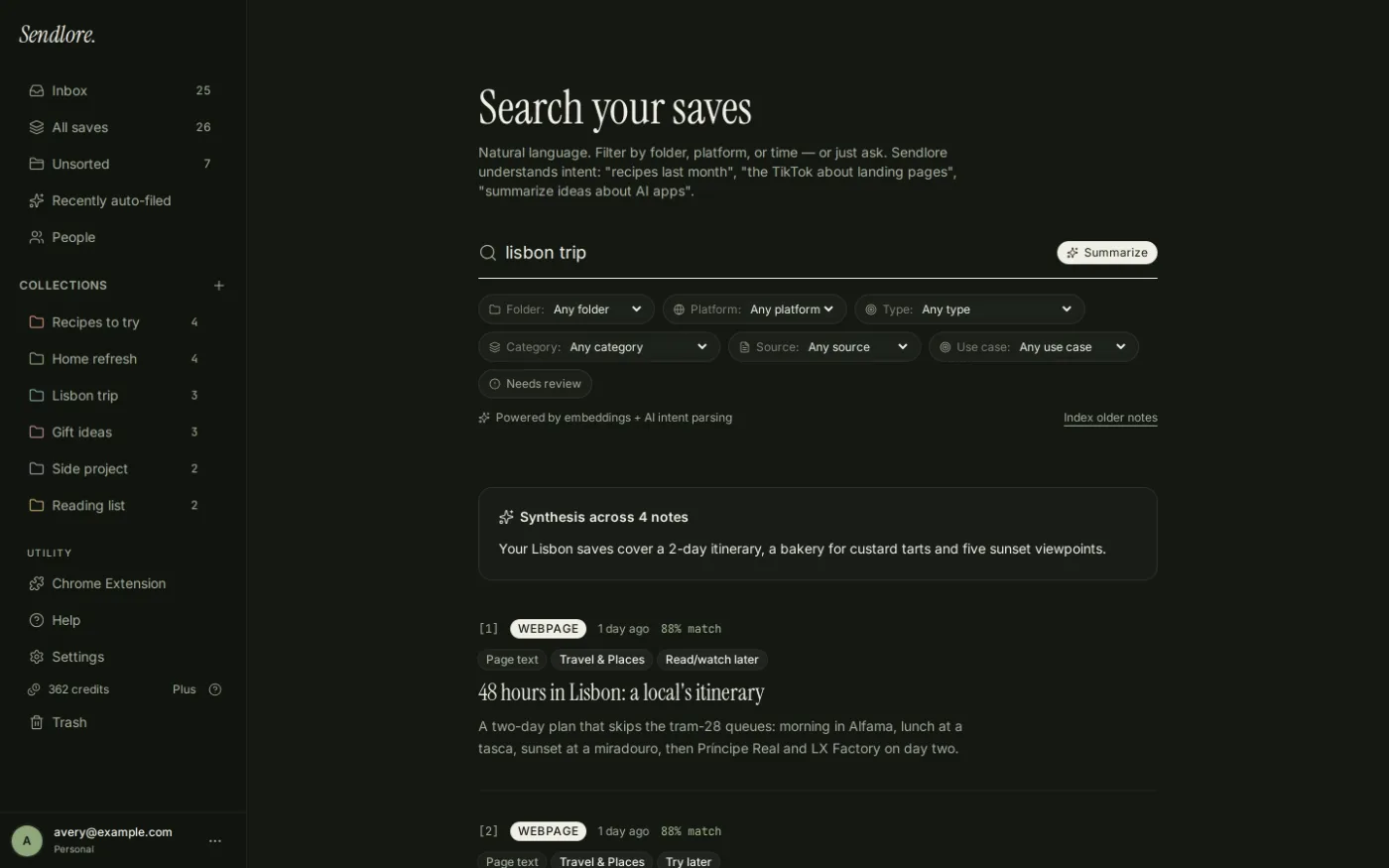
Folders and tags are available when useful, but retrieval does not depend on remembering a flawless filing system months later.
Use a company, feature, problem, quote, idea, platform, or remembered detail. Search combines normal text matching with semantic similarity when the saved evidence supports it.
The same source can matter during discovery, positioning, roadmap work, implementation, launch, and later iteration instead of disappearing with the original sprint.
Founder workflows
Sendlore is most useful when the information has a reason to come back. These are the research loops where a persistent library compounds instead of becoming another dumping ground.
Capture with intent
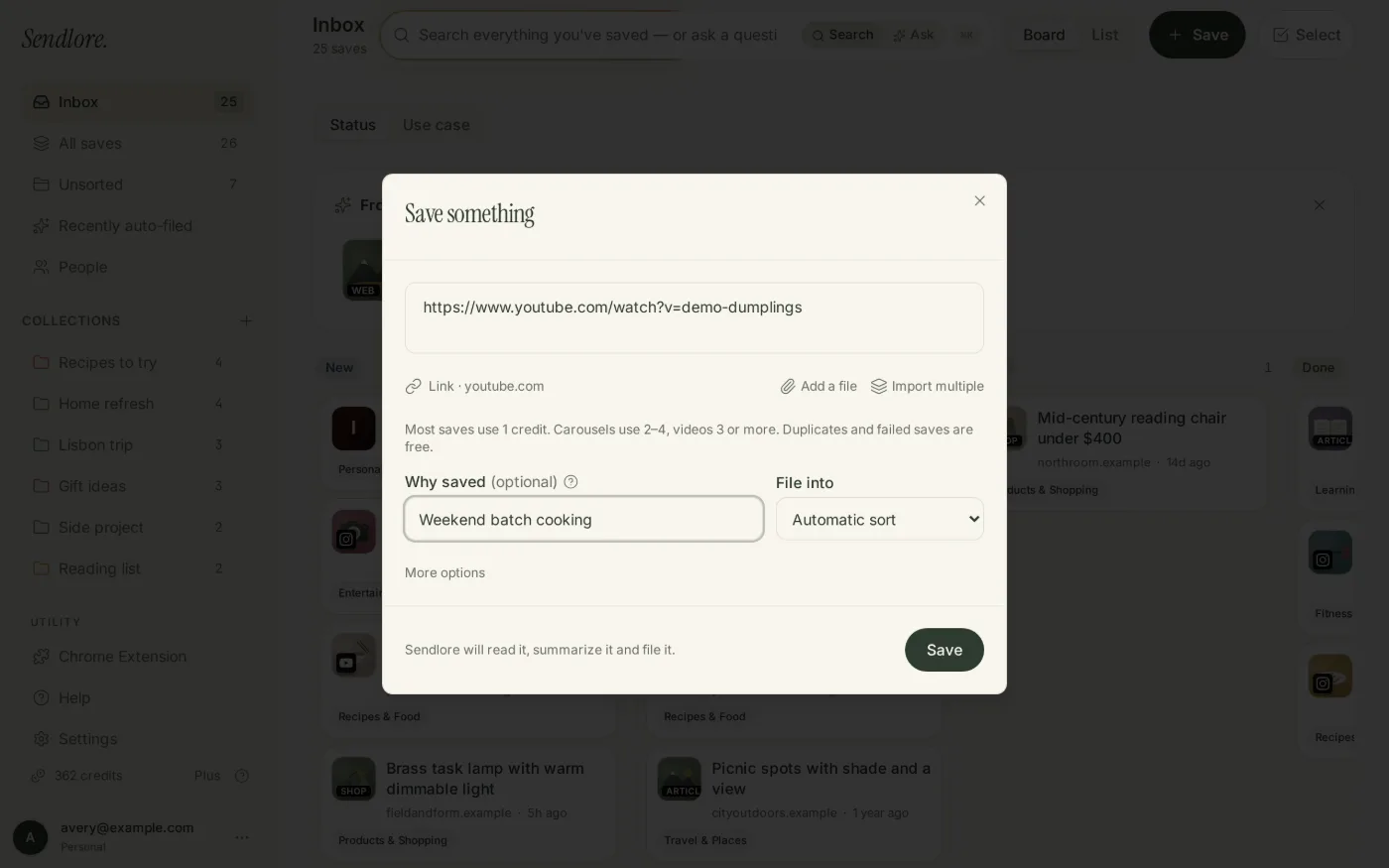
A bare bookmark answers “where was the page?” but not “why was this important?” Sendlore’s capture flow gives you a place to preserve that intent beside the source, which can make the save much more useful after the immediate research session ends.
From research to decision
The value is not a larger archive. It is shortening the distance between “we looked into this before” and the evidence that can actually inform what you do next.
Ask your saved research
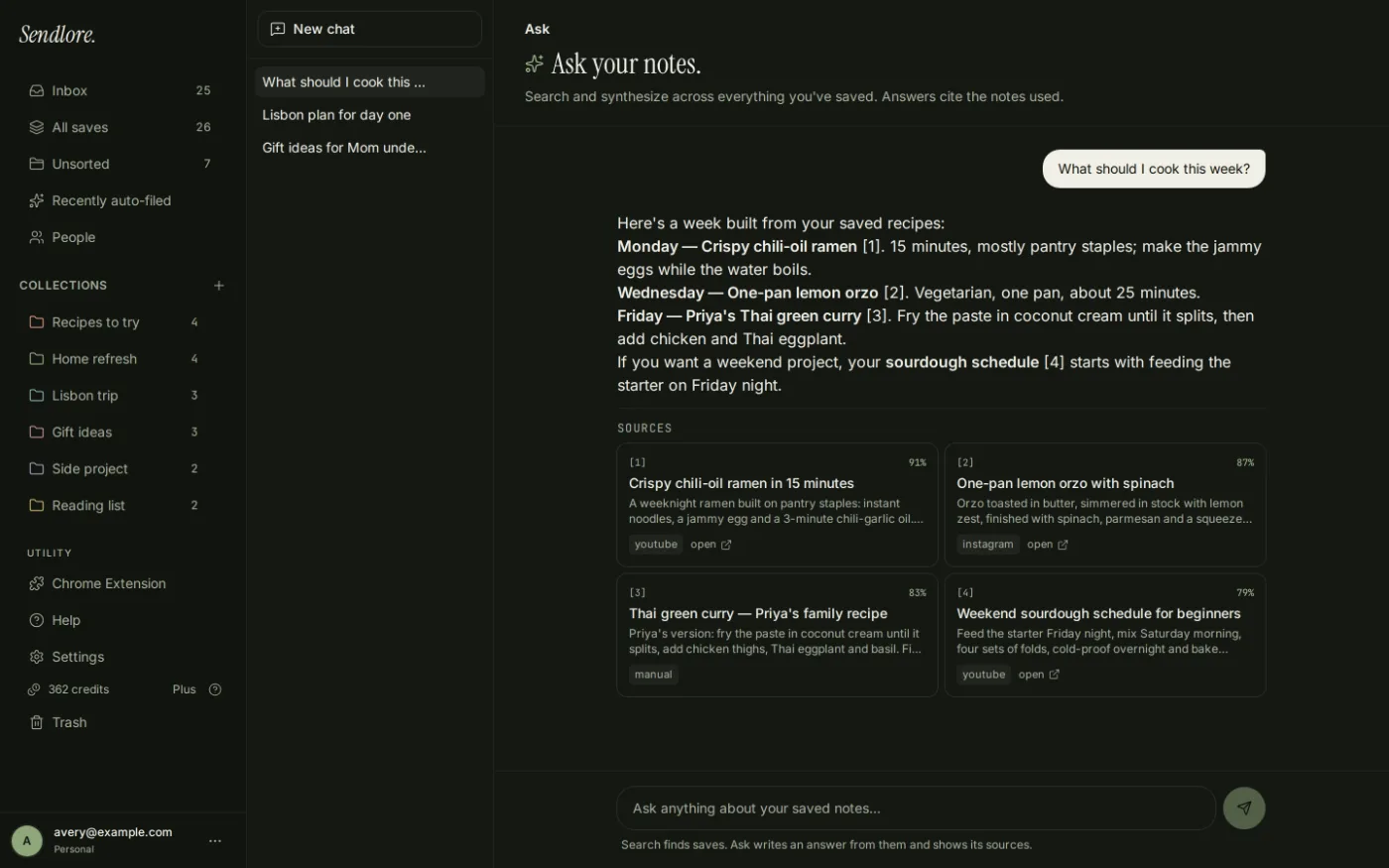
Ask is useful when the answer may be spread across several saved items: what objections keep appearing, which competitors use a certain pricing pattern, what implementation approaches you saved, or what evidence you collected around a product assumption.
Its usefulness depends on what Sendlore successfully captured. Important product, market, legal, security, and technical decisions still require checking the underlying source and current reality.
Search by memory
Founder recall is usually contextual: “that Reddit thread about failed imports,” “the pricing page with usage-based credits,” or “the GitHub issue explaining the retry problem.” Sendlore’s search is designed around those fragments.
Where Sendlore fits in the stack
Sendlore is not a source-control system, issue tracker, collaborative wiki, CRM, analytics platform, or formal decision-log product. Its role is narrower: capture useful external and personal research with source context, make it retrievable later, and help you reuse the evidence behind product work. Current Sendlore accounts are personal rather than shared team workspaces.
Evidence boundaries
A public article may yield rich text. A restricted page or platform may provide only metadata. A video may have a transcript, or it may not. Sendlore keeps the source useful even when deeper extraction is limited, but Search and Ask can only work with the evidence actually captured.
Sendlore personal libraries are designed to be private by default, with authenticated owner-scoped access and deliberate sharing for individual saves. Review the Security & Privacy page for current details rather than relying on blanket claims about encryption or third-party processing.
Questions
Anything likely to matter again: competitor pages, market research, customer evidence, technical references, launch examples, product inspiration, screenshots, notes, useful videos, and links related to an active or future product decision.
Yes. You can save competitor pages and supporting research, add your own reason or observation, organize items with folders and tags, and later retrieve them through search or Ask. Sendlore does not automatically guarantee a complete or current competitive-intelligence database.
You can save supported sources, notes, screenshots, and references that contain useful customer evidence and attach context about the product problem they relate to. Sendlore is not a CRM or dedicated feedback-management platform.
It can save URLs and supported captures and make successfully captured text and your own notes searchable. Access restrictions, dynamic pages, and other source limitations can reduce extraction depth, so keep the original link as the authoritative reference.
No. The current product is built around personal, owner-scoped libraries rather than multi-user team workspaces. It can complement the shared systems your team already uses, but it should not be positioned as a replacement for a collaborative wiki or project-management tool.
Yes. Sendlore supports browser bookmark imports and supported saved-content exports. Imported links can remain useful as light saves and gain richer searchable context when deeper processing succeeds.
Personal libraries are designed to be private by default. Sharing an individual save is a deliberate action. See Sendlore Security & Privacy for current implementation details and limitations.
Stop rebuilding the same research trail
Save useful sources with the context that made them matter, then find that research again when the next feature, pricing decision, implementation problem, or launch needs it.